

Finding a home in America
The Holocaust Survivor Immigrant Experience

Commemoration Photos: Darrell Owens Photography
Yom HaShoah | Tuesday, April 14, 2026
Adela Peskorz
Daughter of Holocaust survivors Ida and Irving Zylbar z”l
Ben Cohen
Grandson of Holocaust survivor Judy Meisel z”l
Adela and Ben spoke at the 2026 Minnesota and Dakotas Erev Yom HaShoah Commemoration: Finding a Home in America – The Holocaust Survivor Immigrant Experience
—
From Adela: [view recording]
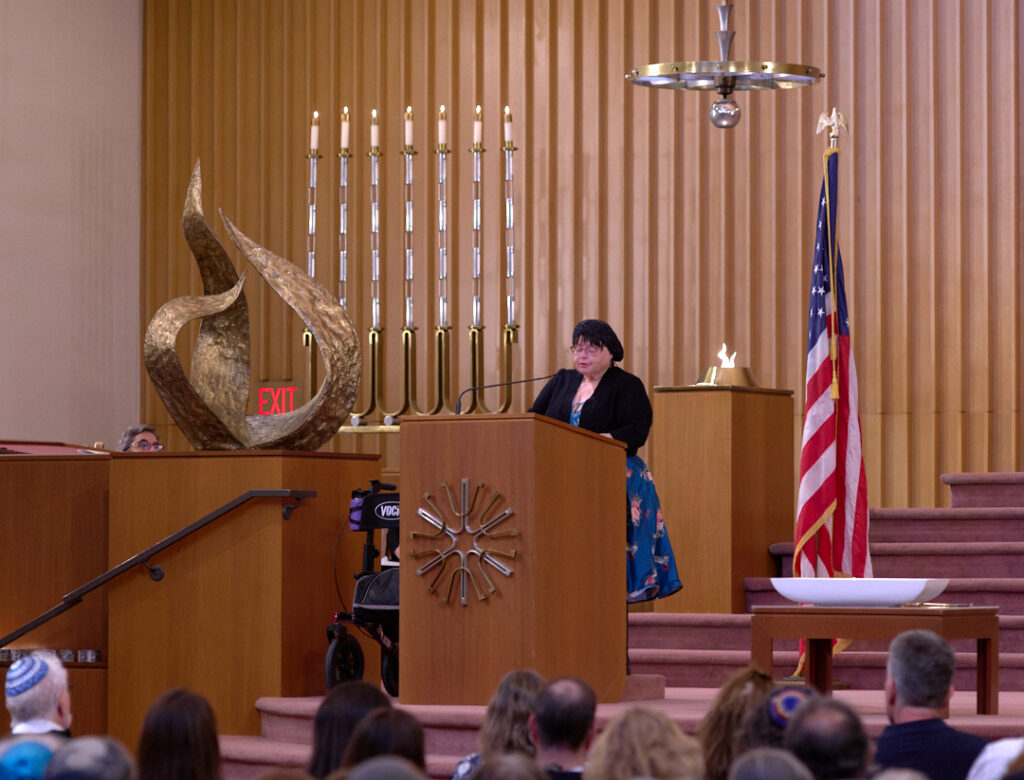
My name is Adela Peskorz, I am the daughter of Holocaust survivors, and along with my husband and daughter-in-law, I am here tonight with my son and grandson, third and fourth generation descendants, and together we are the living memorial candles to my parents, the worlds they lost, and the worlds lost to us.
This year’s theme is “Finding a Home in America,” and I can tell you that for my parents that road was long, arduous, and at times desperate—they waited for three years in a Displaced Persons (DP) camp before they were successfully sponsored by a cousin in New York—and while there were many obstacles in their path, including cultural, psychological, and financial challenges once they arrived, they never ever forgot the sanctuary of freedom they found here, unlike any they had ever experienced.
My mother, Ida Zylber, was 15 when, in late August of 1942, she escaped a massive Einsatzgruppen—the Nazi’s mobile killing units–when more than 14,000 Jews and Romani were murdered. It was both the greatest irony and the greatest miracle that Nazi precision ultimately saved my mother’s life: because not enough graves were initially dug, women were sent back behind barbed wire while new trenches were ordered and in that time someone had smuggled wirecutters to those imprisoned.
My mother’s mother saw the hole in the fence that was torn open and pushed my mother through, yelling at her to run, and run she did, along with about a thousand others, dodging an unceasing volley of bullets across an open field until she remained one of a very tiny handful of people to make it into the surrounding forest, where she hid or was hidden for the next three years. During that time she suffered extreme privation, witnessed and barely escaped numerous horrific atrocities, and learned that the Baptist family who hid her for many months was betrayed by neighbors and all burned alive in their home. Like so many Righteous Gentiles, they paid the highest price for their courage, and it is still one of my great heartaches that I never learned their names so that I could have their heroism recorded at Yad Vashem.
My father, Irving Zylber was from the small Polish town of Ostrow-Lubelski. He and his brother were returning home when a neighbor warned them away and they began running for their lives, jumping onto moving trains and crossing the Bug River into Russia. During their escape they met several others they knew who said the danger had passed and despite my father begging his brother not to listen, he turned back, never to be seen again.
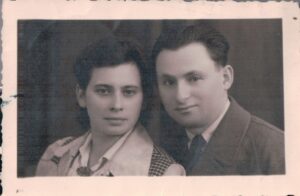
My father was the youngest of eight siblings and he was the only member of his very large immediate and extended family to survive, but his situation was also horrific: while he was in Russia he was reported to the police and he spent years suffering brutality and starvation in Siberia, freed only when he was conscripted into the Polish army to march back to Poland as part of the liberating force during which time he survived a gunshot wound in battle that left his arm permanently disabled.
My parents met in Lublin just after the war in 1945, and like so many returning survivors married almost immediately. They would have remained in Poland, but as my father always said, “every morning you’d wake up to find another dead Jew in the street,” so, they fled to Germany where they were assigned to the Wasseralfingen Displaced Persons camp in Stuttgart. Desperate to find a path to immigration and too often grappling with hopelessness in that long quest, they remained in the camp for three years until 1949, when their sponsorship was finally approved and they and my older sister, born at St. Otillien Hospital in 1946, were able to board the USS General Stuart Heintzelman and set sail for New York.
When they arrived they literally had nothing, and were it not for my cousin and her husband, who sponsored them and took them into their one-bedroom apartment in the Bronx, already crowded with their own family of three children, they would have been totally destitute. In addition to signing up for free English language classes (and they remained self-conscious about their English skills all of their lives), my parents immediately focused on digging themselves out of poverty. My father pushed a pushcart of clothing items up and down the streets of Spanish Harlem and my mother (a lightning quick study and an incredibly hard worker) lied about her sewing skills to a factory owner and worked 12-hour days sewing heavy men’s coats in the garment district, ultimately earning $150 a week, an almost unheard of amount for a woman in the 1950s. Eventually, they saved enough to buy a storefront in Harlem, running “Ida’s Uniform Center” for almost 40 years, and purchase a coop apartment in Flushing, Queens, where I grew up.
Despite these successes, the shadow and ghosts of the Holocaust never left them and those demons remained haunting presences in their reality and all our lives, hovering specters influencing every decision. While my father never spoke about his experiences and my mother never stopped, they had in common the torment unleashed in the moans and cries of their nightmares, which my sister and I could hear many nights, and I can still instantly visualize my child hand on the doorknob every single time I was about to leave the house, hearing the terror in my mother’s voice as she warned me to always look behind me everywhere I went; for her the Nazis were still hiding in every bush and tree, waiting to attack.
After immigrating, my mother battled overwhelming depression, often unable to lift herself out of bed for days. One day a friend came by and said “Ida, we’re going to the movies” and took her to see a Marx Brothers film. It seems so little, that something both so universal and yet so quintessentially American could trigger such a critical shift, but for the first time in MANY years she was able to laugh again. That simple but powerful epiphany transformed her sense of hope and reignited her will to live, quite literally enabling her to move forward again one courageous step at a time.
I do want to say that there were times they still experienced antisemitism even here, learning again it was not a thing of the past, but they also knew this was a matter of scale: never again would they be hunted as they had been, each morning waking to instantly scan their surroundings to determine if this would be a day they had to run.
One integral foundation for my parents here was connection to other survivors. I remember many Sunday mornings when they gathered around a buffet of lox and bagels, herring, knishes and lukshen kugel, the earthy tones of Yiddish forming the lively soundtrack of their conversations. To this day I cannot remember a single name or face, but what I always recall are the outstretched arms, almost all of them with numbers tattooed, broadcasting their shared tragic histories. All of them were able to resurrect their lives from ashes BECAUSE America embraced them, offered them safety and opportunities they could only have dreamed of in their earlier lives, and that is something my parents never ever forgot.
Now, more than ever, sharing and honoring that history is so important, and it is a legacy I now pass on to my son and my grandson as a light to carry forward into the future.
—
From Ben: [view recording]
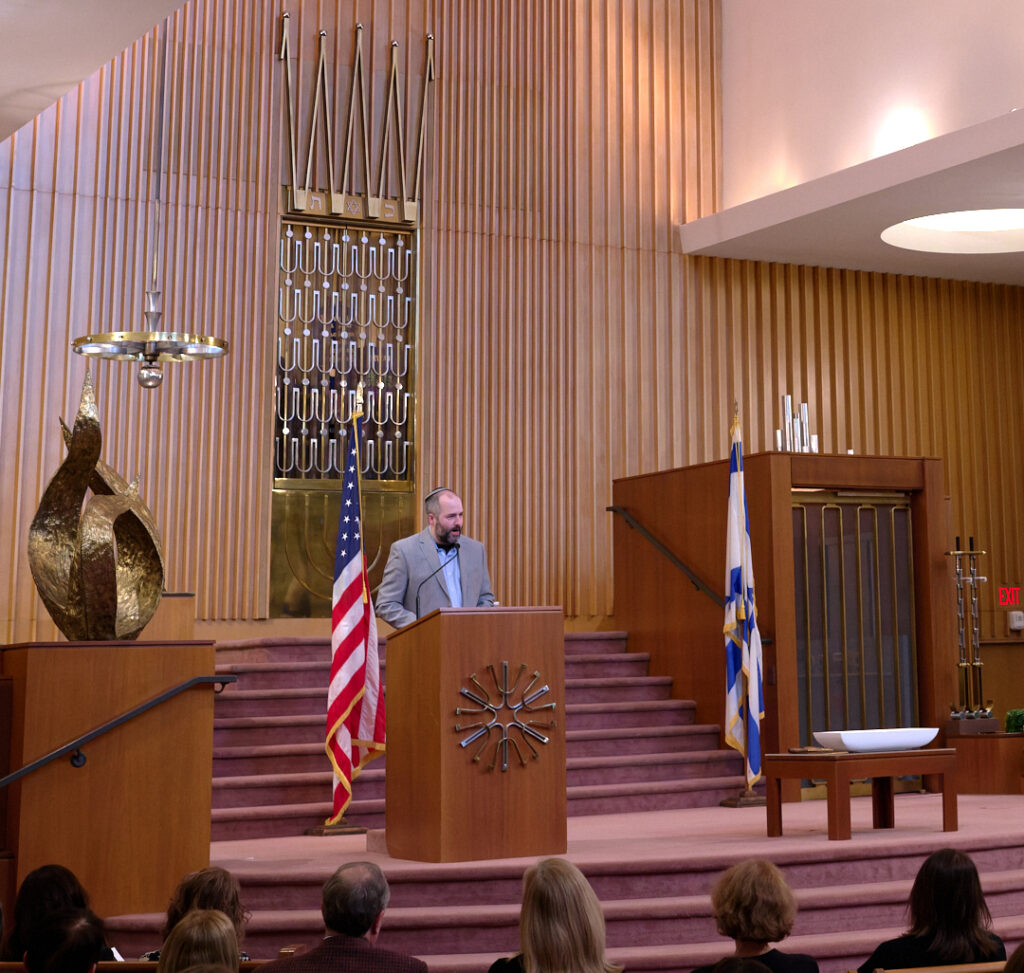
I’m Ben Cohen and I’m the grandson of holocaust survivor, Judy Meisel. We called her Savta. I’m here tonight to fulfill a promise that Savta made, as a teenager in a death camp, a promise she kept her entire life — to tell the story of what happened to her — and to reflect on the lessons that she brought to America as an immigrant.
Savta was born in Lithuania in 1929, the same age as Anne Frank and Martin Luther King Jr. She was the youngest of three children. Savta was 12 years old when the Nazis invaded Lithuania. Antisemitism was already at a fever pitch, and under Nazi rule our family was first forced to live in the Kovno ghetto where death, disease, and starvation were rampant. Two years later Savta, her sister Rachel and their mother Mina were deported by train to Stutthof concentration camp.
The deadly conditions in Stutthof were unimaginable for anyone, let alone two teenage sisters. Savta described the torture when they arrived at Stutthof — as they stepped off the train they were whipped and a female guard shouted “You’ll never get out of here alive.” Savta watched as her mother Mina had her gold teeth ripped out and two guards had fun ripping Savta’s hair from her head. Conditions in the camp were horrific. Prisoners were made to stand for hours in freezing winter. Bread was rarely given and most meals consisted of soup made from potato peels and sawdust, and there was never enough. If you didn’t die from starvation, you were forced into slave labor. Bodies piled higher every day. In her barracks, Savta and other prisoners promised one another that if anyone got out alive, they would tell what happened so nobody could forget them.
In November 1944, my great grandmother Mina was selected for the gas chamber at Stutthof. Savta did not want to be separated from her mother and she clung to her mom, soon finding herself in line, undressing — but a guard ordered young Savta back to her barack. As the guard gave her a count to 3 in German, Mina screamed for Savta to run and so she did. It was the last time Savta saw her mother. She found Rachel and told her they don’t have a mother anymore.
A few months later the sisters were sent with a large group of prisoners on a death march. As Russians began bombing the area, chaos erupted and Savta and Rachel took cover in a ditch. They hid there until they could escape — embarking on a harrowing journey across occupied Poland. Through an incredible series of luck and determination, they ended up being sheltered in a displaced persons camp in Denmark, hiding among Nazi collaborators and sympathizers that had fled Poland as the Russians gained control of the area. When Denmark was liberated on May 5, 1945, Savta and Rachel came forward to the Red Cross and said they were Jews. Nobody believed them until they signed their names in Hebrew.
After the war, Savta and Rachel received a postcard — their brother Abe had survived Dachau and was living in Canada. Savta, for the first time in her life, left her sister and made the bold decision to set sail across the Atlantic to find her brother and begin a new life as an immigrant. She boarded a ship and that’s where she met my grandfather, Gabe, who was on his way home after fighting in Israel’s war of independence. Savta reunited with her brother, and later Rachel immigrated to Canada where she lived for the rest of her life.
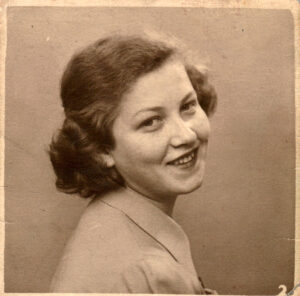
For Savta, that was only chapter one of her incredible life of survival and courage. Then she came to America. My grandpa Gabe and Savta first moved to Brooklyn in 1952. As Gabe worked various jobs in Jewish education they moved to Rochester, New York, then Delaware before my grandpa got a job as the principal of Solomon Schechter Day School in Philadelphia. They spent summers working at Rama in the Pocconos. As she came to build a life here in America, rooted in Jewish values and growing her family, Savta found freedom here in America. But when she saw the prevalence of racism within her own community, she could not sit idly by.
By 1963, Savta had been in America less than a decade. As a survivor and immigrant, she was shocked to witness what was happening as the first Black family, the Bakers, moved into an all-white neighborhood of Folcroft, Pennsylvania. The city of brotherly love quickly opened wounds of the hatred Savta knew too well as a child.
Just a few miles up the road, a full-scale riot erupted as neighbors turned on the Baker family, threatening their lives and their home. They wanted them out. State troopers were sent to keep the peace. Known as “The Folcroft Incident,” it is today considered a significant event in our country’s civil rights movement. Judy described watching the news and in her words “It was like Kristallnacht all over again. If their rights were being trampled on, I knew my rights were being trampled on, too.”
Savta baked cookies and brought them to the family. It was her literal first step in becoming a civil rights activist. A simple gesture — looking after her neighbors, something nobody did for our family living under Nazi rule. She also began telling her story publicly for the first time, keeping the promise she made in the camps to her fellow prisoners. Speaking up for the marginalized and those under attack, exercising her freedom of speech, became her calling. Sharing her Jewish values and the memories of her mother — to tell the world that we are all responsible for one another.
She began traveling with the Panel of American Women, a grassroots civil rights organization that hosted moderated discussions of women from mixed ethnic backgrounds to promote tolerance and understanding. She broke bread with Martin Luther King Jr, marched for equal rights, and above all else ignited a life-long commitment to telling her own story as a warning about what happens when hatred is left unchecked, and how easy it is for neighbors to be convinced to turn on one another through scapegoating and lies. If I were to guess, and I’m not trying to exaggerate, in her lifetime, Savta may have told this story to more than hundreds of thousands of people. One classroom, one auditorium, one interview, one willing listener at a time.
When Savta moved to Santa Barbara in the 1980s she founded Beit Heyaladim, a Jewish preschool at Congregation B’nai Brith, that still thrives today. She traveled the world telling her story and received countless community service awards — her home adorned with recognition of her legacy and impact — plaques honoring her from the California State Legislature, awards from the ADL, and her most beloved, countless letters from high school students thanking her for sharing her story in their classrooms. She participated as a key witness, providing first-person testimony in late German trials of Nazi guards — earning her the FBI Director’s Community Service Award in 2018, and in 2020 leading to the conviction of a guard from Stutthof for accessory to mass murder.
She taught her grandchildren how to make latkes and mock chopped liver. She kept Shabbat. And she kept that promise — to bear witness. Savta had often told me growing up that this is the greatest country in the world. Not because we’re perfect, but because she found her voice here. If Judy were here today, she would tell you all right now that after listening to this story, you’re all witnesses, too. And I ask you to join me to help her keep that promise she made to make sure nobody will ever forget, and to honor her by not taking for granted how you use your voice and your freedom to fight hate.
This blog post was the featured staff column for the April 2026 Gesher (‘Bridge’ in Hebrew) – JCRC’s monthly email newsletter.
Subscribe
###