
Choosing Proximity: The Case for Liberal Zionism
What two Israeli women taught me about what resisting terror really means

Pictured: The Amplify Israel rabbinic delegation in Jerusalem, January 2026
By Rabbi Jill Avrin
Director of Campus Affairs
Jan. 15, 2026
“The closer you are to something, the more you see the real picture of what is going on there. The farther away you get, the reality starts to fade, and eventually you end up in La La Land.” This wisdom was imparted by Sameer Sinijalawi, a Palestinian leader calling for the Palestinian national movement to recognize Israel as a Jewish state a pre-requisite for a Palestinian state.
Sameer was one of 30 leaders I met with in Israel last week, as part of a delegation of 25 rabbis participating in the Stephen Wise Free Synagogue of NYC Amplify Israel initiative. Amplify Israel is grounded in אהבת ישראל ahavat Yisrael—love and responsibility for the Land, People, and State of Israel. It seeks to renew progressive Jewish identity through a liberal Zionism that strengthens universal values by practicing them within real covenantal communities, rather than merely claiming them in theory.
Our delegation was privileged to meet a range of leaders representing a broad spectrum of Israeli society. We heard from heroes who saved hundreds of people on October 7th, ordinary citizens who embody the essence of ahavat Yisrael, and thought leaders shaping Israel’s post October 7th future.
But the stories of two women, who are as close to the reality here as anyone, showed me what true resistance against evil looks like.
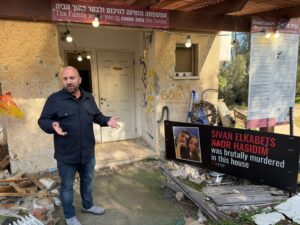
Leora Eilon, a self-described “peace-nik” from K’far Aza, had two messages she wanted us to receive.
First, her world changed forever on October 7th.
Second, she refuses to let the world change her.
Leora’s son, Tal, was murdered on the 7th, while her community was viciously attacked. Sixty-two of her friends and neighbors were murdered in one day. Nineteen were kidnapped and taken to Gaza and held captive underground for as long as two years. The Kibbutz will welcome residents back this summer and is starting the difficult work of rebuilding after so much loss. Leora told us that she knows peace will never be possible with Hamas, yet she still believes that peace with Palestinians could one day be possible. in a future we haven’t yet imagined.
Dr. Cochav Elkayam-Levy has spent the past 27 months documenting and raising global awareness of the atrocities committed in Southern Israel on October 7th, especially the sexual violence that targeted women, children, and families during the October 7th attacks.
Her research identified a new category of terrorism, kinocide—systematic targeting and destruction of family units, where familial bonds are weaponized as a form of psychological and physical violence. Hamas terrorists deliberately murdered and tortured family members in front of each other and broadcast their victims’ abuse on the victims’ own social media pages to exacerbate the psychological trauma.
Cochav fully understands that Hamas, like other Islamist terror movements, aim to radicalize people like her—people who believe in human rights and in coexistence between Israelis and Palestinians—into their own hateful extremism.
But she refuses to give them that victory. She reminded us that resistance against evil isn’t only fought on the battlefield—it’s fought by guarding our souls against the corrupting temptations of hate and revenge.
These heroic women remind me of Rabbi Emil Fackenheim’s 614th commandment, to refuse Hitler a posthumous victory of allowing Jewish civilization to die after the Holocaust. Our parents and grandparents took on this mitzvah by building vibrant Jewish communities in the shadow of the Shoah.
Our generation must bring it to new heights: a 615th commandment—not only to win the war against Israel’s enemies, but to do so with our moral, political, and spiritual integrity intact.
Their stories—overcoming evil without being corrupted by it—inspired me in ways I wasn’t expecting but desperately needed. But they also weren’t exceptions. They represented the most salient examples of a wider Israeli struggle to resist not only terror itself, but the moral collapse terror seeks to produce.
Their clarity helped me see liberal Zionism—a hybrid commitment to Israel’s Jewish and democratic identities—as a form of resistance that recognizes the necessity of Jewish power while insisting it be exercised with responsibility, humility, and a refusal to dehumanize.
Liberal Zionist leaders like MK Rabbi Gilad Kariv and the other Israeli Reform rabbis we met embody this resistance daily. Despite political and structural odds, they are expanding Jewish community, meaning, and service while holding Israel accountable to its highest ideals: upholding a structure of democracy, equality for all its citizens, security without cruelty, and maintaining a horizon for peaceful coexistence—without illusion or surrender.
The pressures facing American Jews are different, but they are not unrelated. Israelis face threats to their physical survival. American Jews increasingly face pressure to abandon moral clarity: to apologize for Jewish peoplehood, to distance ourselves from Israel to earn acceptance, or to reduce Zionism to caricature.
Distance makes it easier to live in abstraction. Proximity demands responsibility. That is what Sameer Sinijalawi meant—and what Leora and Cochav live.
Ahavat Yisrael is not thoughtless loyalty. It is a commitment to stay close: to people, to truth, and to moral complexity—even when it is uncomfortable. For American Jews, this means showing up for Israelis, staying informed, traveling to Israel, and speaking honestly with our neighbors about what Zionism is, rather than allowing the libels of antizionism to define it for us.
At a time when hatred seeks to simplify, to radicalize, and to corrupt, choosing proximity may be the most meaningful form of resistance of all.
This blog post was the featured staff column for the January 2026 Gesher (‘Bridge’ in Hebrew) – JCRC’s monthly email newsletter.
Subscribe
###