
Power in Partnership
How JCRC and Humanus Network are transforming Holocaust education

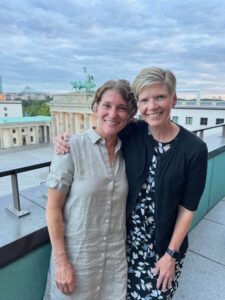
Pictured: Kristin Thompson photographed at Treblinka Death Camp on Power of Place
Lev Gringauz, TC Jewfolk
An Interview with Kristin Thompson, Founder of Humanus Network
October 9, 2025
When Kristin Thompson left Washington, D.C. to return home to Minnesota, she wasn’t sure what was next. After years immersed in Holocaust education at the U.S. Holocaust Memorial Museum, Kristin took a short detour into the world of travel — but something kept calling her back. “I felt like I was missing out on my calling,” she reflects. That calling was Holocaust education — and through it, empowering teachers and impacting students.
Now, as founder of Humanus Network, Kristin partners with the Jewish Community Relations Council of Minnesota and the Dakotas (JCRC) to offer transformative professional development experiences for educators. The partnership has become a national model for meaningful Holocaust education, rooted in relationships, intentionality, and deep historical knowledge.
We sat down with Kristin, along with Susie Greenberg, JCRC Director of Holocaust Education, to talk about the evolution of their collaboration, the power of experiential learning, and how their work is shaping the future of Holocaust education in Minnesota and beyond.
Q: Kristin, can you start by sharing a bit about your background and how it led to founding Humanus Network?
Kristin:
I was a history teacher in Minnesota for nearly 20 years, most of that time in Redwood Falls, a rural community with a large Native American population. In 2013, I joined the U.S. Holocaust Memorial Museum in D.C., where my main role was training educators through programs like the Belfer National Conference and the Museum Teacher Fellowship. I mentored educators from across the country, helping them bring Holocaust education into their classrooms in meaningful ways. Additionally, I represented the Museum at conferences around the globe, working with teachers, museum educators, and leading experts in the field.
Eventually, my husband and I decided it was time to return home to Minnesota. The emotional toll of being immersed in Holocaust history 24/7 is real. I took a short break and worked for a travel company — but I couldn’t shake the feeling that I wasn’t where I was meant to be. Eventually, I took a leap and started Humanus Network. I didn’t know if it would work, but doors started opening — especially through my partnership with JCRC. It’s grown far beyond what I imagined.
Q: What is Humanus Network today?
Kristin:
I chose the name because it refers to the study of human nature (Humanus). The Network is a web of experts and educators with whom I’ve worked over the past 30 years; relationships I’ve cultivated and nurture. So when someone partners with me, they’re not just getting my expertise, they’re getting access to people like Paul Salmons, who curated the Holocaust exhibition at the Imperial War Museum in London, or Carl Wilkins, the only American who stayed in Rwanda during the genocide.
Together with JCRC, we’ve created programs like Power of Place, an immersive study trip to Holocaust sites in Europe, and the Holocaust Educators Cohort, which helps teachers build strong foundational knowledge, a component that is absent from programs offered by other leading institutions and organizations. And now, we’re developing a certificate program for Minnesota educators, in response to the state’s new mandate on Holocaust and genocide education.
Q: Susie, how did this partnership between JCRC and Humanus Network come to be?
Susie:
Our relationship started when Kristin was still at the museum. We did a joint workshop in Fargo-Moorhead with college students going into teaching. Kristin represented USHMM, and from that first experience, it was clear our visions aligned. When she returned to Minnesota, we were eager to collaborate again. And honestly, it just took off. We share the same values and goals — it’s a seamless partnership.
Q: Kristin, you mentioned Power of Place. Why are you especially proud of that program?
Kristin:
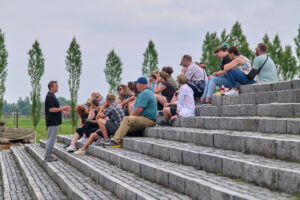
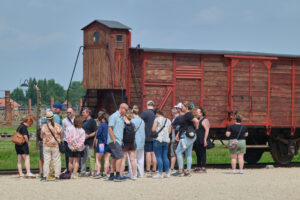
Power of Place is a passion project — taking teachers to authentic Holocaust sites, standing where the history happened. As we lose survivors, visiting these places becomes essential—they stand as silent witnesses, preserving truth in an age where facts are too often under threat. These journeys don’t just teach history—they illuminate our shared humanity. JCRC shares that passion. Together we make it happen meaningfully.
The impact has been profound. Teachers come back saying it was life-changing. We’ve had educators go on multiple trips as we offer a new itinerary each year. That kind of dedication — especially during their summer — speaks volumes. The depth of emotion, the learning, the sense of community… it’s hard to put into words. But we see it. In journals, in classroom changes, in ongoing engagement.
Susie:
It’s not just logistics — it’s the human side. We now carefully curate the group, because we learned how powerful that dynamic can be. There’s an organic creation of brave space on these trips. Participants feel safe to open up, reflect, connect. That’s where transformation happens.
Q: What makes your partnership with JCRC unique? Why does it work so well?
Kristin:
We’re aligned on a core level. Every idea we’ve brainstormed — whether it’s the cohort, the trip, or now the certificate — we’ve approached with “How do we make this happen?” There’s mutual trust and creativity.
Also, JCRC shares my belief that we need to empower teachers. Many are afraid to teach about the Holocaust because they feel unprepared. Our programs give them the confidence, tools, and content knowledge to do it responsibly. We’re not just checking a box — we’re building capacity for long-term impact.
Q: Tell us more about the certificate program you’re proposing.
Kristin:
It’s a response to Minnesota’s new mandate requiring Holocaust and genocide education. I’m representing JCRC as co-chair of the state’s task force on this topic. We saw that many mandates fail because they don’t include teacher training — and that can actually do harm.
Our idea is to create a multi-week certificate program that includes history, pedagogy, and lessons on other genocides. Participants will develop their own projects and be mentored throughout. It builds on our cohort model and incorporates our network of experts. We hope it becomes a model for the state — and beyond.
Q: Final thoughts — what are your hopes for the future of this work?
Kristin:
That we continue growing this partnership. I hope we keep building — deeper and broader. The certificate program is one example, and we’re already talking about Power of Place year five.
Susie:
The heart of this work is our shared mission — honoring memory through education, empowering teachers to teach truth, and reaching generations of students. That’s what makes this partnership powerful and personal.
From One Idea to 120,000 Students
In just five years, Kristin estimates she’s reached over 1,500 educators — and through them, more than 120,000 students. That kind of reach doesn’t happen alone. It happens through vision, persistence, and trusted partnerships like the one between Humanus Network and JCRC.
As applications open this fall for the next round of programs, the message is clear: this is work that changes lives — and classrooms — for the better.
Interested in applying to the Power of Place tour or registering for the Holocaust Educator’s Cohort?
Visit JCRC’s website for application details, due dates, and more.
This blog post was the featured staff column for the October 2025 Gesher (‘Bridge’ in Hebrew) – JCRC’s monthly email newsletter.
Subscribe
###